Key takeaways
- 1/8 in at 30 ft is 0.347 mm per m and 0.417 in per 100 ft. To convert any laser spec, inches per 100 ft is exactly 1.2 times mm per m.
- Fluke prints its PLS 180R as 1/8 in at 30 ft and 3 mm at 10 m. Those are 0.35 and 0.30 mm per m, so the inch figure is the looser of the two by about 16 percent.
- DeWalt's DW088 is rated 1/8 in at 30 ft, but its pitch-direction field check allows 1/4 in at 30 ft, because turning the laser around counts the same tilt twice. Milwaukee's manual does the same arithmetic on twice the distance.
- Bosch's US cross-line lasers span 5/16, 1/4 and 1/8 in at 30 ft. A 5/16 in tool is 2.5 times less accurate than a 1/8 in one, and the label alone does not say which you have.
- For a quartz top that needs cabinets level within 1/8 in over 118 in, a 1/8 in at 30 ft laser uses a third of the tolerance. Written as 1/8 in over a whole 40 ft run, no laser at that class meets it.
Two readings circulate. One says "plus or minus 1/8 in" is a 1/4 in band, so the laser can be off by 1/4 in. The other says the laser must agree with itself to 1/8 in in any test. Both go wrong at the field check. The spec describes one beam leaving one laser. The check in DeWalt's DW088 manual turns the laser around, counting the error twice, and allows 1/4 in at 30 ft for exactly that reason. Below, five makers' figures go on one scale and the check is taken apart.
The figure is a slope, not a distance
A self-leveling laser's beam leaves its pendulum at some small angle to true level, and over distance that angle opens into a gap. At 30 ft, the maker promises, the gap is no more than 1/8 in either way.
Because it is an angle, it scales with distance. Milwaukee's manual does the scaling itself: "132' x ±1/8" ÷ 33' = ±1/2"." DeWalt's field check table prints 1/8 in at 30 ft, 5/32 in at 40 ft and 7/32 in at 50 ft, and in metric 3.1 mm at 9 m, 4.2 mm at 12 m and 5.2 mm at 15 m, which is 0.344 to 0.350 mm per m all the way out. So write it as a rate:
1/8 in / 30 ft = 0.125 x 25.4 mm / 9.144 m = 0.347 mm per m
0.347 mm/m x 1.2 = 0.417 in per 100 ft
The 1.2 is exact. 100 ft is 30.48 m, 1 in is 25.4 mm, and 30.48 / 25.4 = 1.2. Any mm per m spec times 1.2 is inches per 100 ft.
Five makers on one scale
The makers publish at 30 ft, at 33 ft, in mm per 10 m, or in mm per m. Normalized:
| Laser | As published | mm per m | in per 100 ft | At 30 ft |
|---|---|---|---|---|
| Huepar 901CG | ±1/9 in at 33 ft | 0.28 | 0.34 | 0.10 in |
| Fluke PLS 180R, metric figure | ≤3 mm at 10 m | 0.30 | 0.36 | 0.11 in |
| Bosch GLL 3-80 (UK listing) | ±0.3 mm/m | 0.30 | 0.36 | 0.11 in |
| Milwaukee 3622-20 | ±1/8 in at 33 ft | 0.32 | 0.38 | 0.11 in |
| DeWalt DW088, metric figure | ±3.1 mm per 9 m | 0.34 | 0.41 | 0.12 in |
| DeWalt DW088 | ±1/8 in per 30 ft | 0.35 | 0.42 | 0.125 in |
| Fluke PLS 180R, inch figure | ≤1/8 in at 30 ft | 0.35 | 0.42 | 0.125 in |
| Bosch GLL100-42GL | 1/8 in at 30 ft | 0.35 | 0.42 | 0.125 in |
| Bosch GLL50-20G | 1/4 in at 30 ft | 0.69 | 0.83 | 0.25 in |
| Bosch GLL25-10 | ±5/16 in at 30 ft | 0.87 | 1.04 | 0.31 in |
"1/8 in" is not one class. 1/8 in at 33 ft is 9 percent tighter than 1/8 in at 30 ft, the same gap over more distance. The 33 ft figure is a 10 m figure in inches: Milwaukee's French section prints the 3622-20 as "3 mm (±1/8") à 10 m (33')", although 3 mm at 10 m is 0.30 mm per m and 1/8 in at 33 ft is 0.32.
Fluke's two figures are not the same promise. The PLS 180R reads "≤1/8 in at 30 ft. (≤3 mm @ 10 m)", which is 0.347 against 0.300 mm per m. The inch figure allows about 16 percent more error. Where a maker's two figures disagree, plan on the looser one. DeWalt's pair agrees within 1 percent.
The spread inside one brand beats the spread between brands. Every 1/8 in class tool above sits between 0.28 and 0.35 mm per m. The three Bosch US models here run from 0.35 to 0.87. A 5/16 in at 30 ft laser is two and a half times less accurate than a 1/8 in one, and both are sold as self-leveling cross-line lasers.
Why a two-way check shows double the stated error
A laser cannot check itself from one position, because every mark carries the same error. The manuals reverse it instead. DeWalt's pitch-direction check for the DW088:
- Fix the laser at one end of a wall at least 30 ft long, aimed along it, and mark the beam center at a and b, at least 30 ft apart.
- Move the laser to the far end, aimed back, and set its height so the beam lands on the nearer mark, b.
- Mark c directly above or below a, and measure a to c.
The allowance is 1/4 in at 30 ft, 5/16 in at 40 ft and 13/32 in at 50 ft, or 6.2 mm at 9 m. Twice the spec, and it has to be.
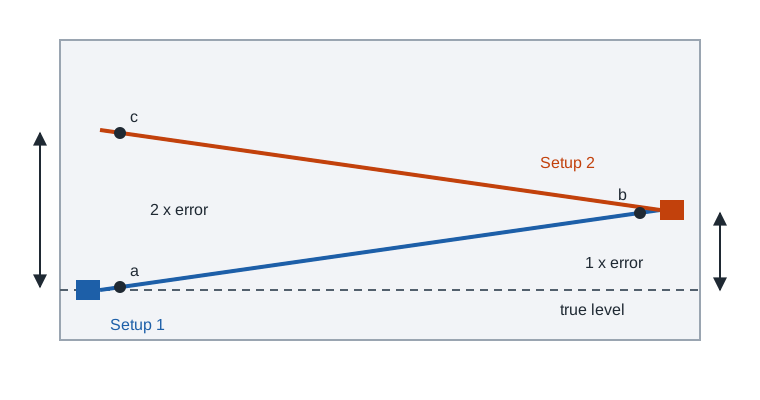
Let the beam rise by an angle e in whichever direction it faces. In setup 1, b is 30 ft x e above a. In setup 2 the laser starts at b's height facing a, and rises another 30 ft x e on the way back, so c is 2 x 30 ft x e above a. A laser exactly at 1/8 in at 30 ft leaves 1/4 in between a and c.
Milwaukee words the same rule as distance. Its 3622-20 height check runs between two walls about 66 ft apart, from beside each in turn, and counts the measuring distance as "2 x 66' = 132'", giving 1/2 in. Its leveling check uses 2 x 33 ft for 1/4 in, and its plumb dot check 2 x 16.5 ft for 1/8 in. Twice the spec at the spacing used, or the spec at twice the spacing: the same thing.
So a 1/4 in result in DeWalt's pitch check does not mean the laser is 1/4 in off, and it is not a failure. It is a laser exactly at its rating. DeWalt's scan-direction check is different: the laser pivots on one wall so the right-hand and then the left-hand end of the line hit the same spot on the opposite wall. It compares two parts of one line at one distance, and its allowance is the spec itself, 1/8 in at 30 ft.
Plumb is not covered by the level figure. The DW088's specification table lists only "Accuracy (Level)". Its vertical check is also a reversal, from each end of a 5 ft floor line to the ceiling, and allows 1/8 in at 8 ft up to 3/8 in at 20 ft, or 3.4 mm at 2.5 m to 8.2 mm at 6 m. That is 1.36 to 1.40 mm per m between the marks, about 0.69 mm per m once halved, twice the level rate. That derivation is ours, not a figure DeWalt prints. Milwaukee's door-frame check allows 2 x 7 ft x 1/8 in / 33 ft = 0.05 in in a 7 ft door, the level rate, so per foot of height DeWalt's table allows two to two and a half times as much. Where plumb matters, read the vertical table.
When 1/8 in at 30 ft is not good enough
A laser's error only matters against a tolerance. Two published ones show the range.
Countertops on a cabinet run. M S International's guidelines for its Q quartz say: "The tops of the cabinets must be level within 1/8" over a 118" length." That is 1.06 mm per m. Over those 118 in (3.0 m), each laser class takes this much:
| Laser class | mm per m | Error over 118 in | Share of 1/8 in |
|---|---|---|---|
| 1/9 in at 33 ft (Huepar 901CG) | 0.28 | 0.033 in | 26% |
| 1/8 in at 33 ft (Milwaukee 3622-20) | 0.32 | 0.037 in | 30% |
| 1/8 in at 30 ft (DeWalt, Fluke, Bosch GLL100-42GL) | 0.35 | 0.041 in | 33% |
| 1/4 in at 30 ft (Bosch GLL50-20G) | 0.69 | 0.082 in | 65% |
| 5/16 in at 30 ft (Bosch GLL25-10) | 0.87 | 0.102 in | 82% |
The 1/8 in at 30 ft class leaves two thirds of the tolerance for shimming and marking. The 5/16 in class leaves less than a fifth.
Now a 40 ft run. Read per 118 in, as written, a 1/8 in at 30 ft laser is fine all along it, because its slope is the same in every section. It fails when the job sets 1/8 in end to end over the whole 40 ft, because a continuous top or a row of doors has to sit on one line. The laser's own allowance at 40 ft is:
0.125 in x 40 / 30 = 0.167 in (DeWalt's table prints 5/32 in, 0.156 in)
That is past 1/8 in before any other error. A 1/8 in at 30 ft laser can promise 1/8 in end to end only up to 30 ft of run, a 1/9 in at 33 ft laser up to 37 ft. Setting the laser in the middle does not help: a tilted beam reads high at one end and low at the other, and the difference is still the slope times 40 ft.
A suspended ceiling grid. Armstrong's instructions say "Main beams must be level to within 1/4" in 10'," which is 2.08 mm per m. Over 10 ft a 1/8 in at 30 ft laser accounts for 0.042 in, a sixth of it, and even the 5/16 in class only 0.104 in. Every class in the table is good enough for the grid. What the grid hangs from is a separate question, covered in the overhead storage safety guide.
The line has width. Fluke lists the PLS 180R's line at "≤2 mm at 5 m". At 5 m (16.4 ft) the 1/8 in at 30 ft spec allows 1.7 mm, less than the line is wide. Mark the top edge on one cabinet and the bottom edge on the next and the marking adds more than the laser does. DeWalt: "Always mark the center of the beam created by the laser."
Temperature, drops, and storage
The figure on the box is for a laser in calibration, and both manuals say it does not stay that way on its own. DeWalt: "Extreme temperature changes may cause movement of internal parts that can affect accuracy," and if the laser has been dropped, check that it is still calibrated. Milwaukee: "Ambient temperature gradients can impact laser accuracy," and impacts from a drop "can also lead to deviations in product accuracy." It calls for the field check on unboxing and "after any impact or before completing any critical jobs". The 3622-20's 1 m drop rating says it survives a 1 m drop, not that it stays in calibration after one.
| Laser | Operating | Storage |
|---|---|---|
| DeWalt DW088 | 14 to 122 F (-10 to 50 C) | -5 to 140 F (-20 to 60 C) |
| Fluke PLS 180R | 14 to 122 F (-10 to 50 C) | -0.4 to 122 F (-18 to 50 C) with batteries |
| Milwaukee 3622-20 | 14 to 104 F | -4 to 120 F |
| Bosch GLL100-42GL | 14 to 113 F (-10 to 45 C) | not listed on the product page |
| Bosch GLL25-10 | 41 to 104 F (5 to 40 C) | not listed on the product page |
A GLL25-10 used straight out of a 35 F garage is below its operating range. The 120 and 122 F storage ceilings are the same kind of limit that makes a closed truck in summer a problem for batteries, as covered in whether tool batteries can stay in a truck box. After storage in heat or cold, Milwaukee says to allow "at least 2 hours to acclimate to ambient temperature before turning on the tool." DeWalt says to store the DW088 "in the kit box provided", never wet. Carried in a modular box, a laser is the kind of contents the IP ratings guide says to protect with foam and a controlled interior, not a higher IP number alone. It is a calibrated instrument, like the click wrench in the torque wrench storage guide: its number holds only inside its limits.
The field check, step by step
- Check at the job's distance. DeWalt: "It is important to conduct a calibration check using a distance no shorter than the distance of the applications for which the tool will be used." A 15 ft check proves nothing about a 40 ft line.
- Let the laser reach room temperature, and set it off the floor in the center of the working area, as Milwaukee advises.
- Mark the center of the line every time.
- In a reversal, halve the gap before comparing it with the spec. Up to 1/4 in at 30 ft passes a 1/8 in at 30 ft laser.
- In a single-direction check such as DeWalt's scan check, compare the gap with the spec directly.
- Over the limit, DeWalt says the laser "must be serviced at an authorized service center", and Milwaukee says to contact its service facility.
Where this answer stops applying
- Other instruments. Everything here is for self-leveling cross-line lasers and the five makers' own published figures.
- Beyond the visible range. DeWalt rates the red DW088 to 50 ft without a detector, Milwaukee the 3622-20 to 125 ft. The rate continues past that, and reading the line does not.
- Setup errors. The spec covers the beam, not a laser set outside its roughly 4 degree self-leveling range, where DeWalt says the flashing beams are "NOT LEVEL OR PLUMB", and not errors in carrying a height from one setup to the next.
- The Bosch GLL 3-80. Its ±0.3 mm per m comes from Bosch's UK listing, with footnote marks the page does not explain.
For hanging the cabinets once the line is on the wall, the fastener side is in what screws to use for garage wall cabinets, and where the run sits relative to benches and doors is in the garage shop layout guide.