Key takeaways
- Manufacturers specify anything from a 5/16 x 1-1/2 in lag to a 1/4 x 2-1/2 in screw, four per cabinet where a count is printed, always into studs.
- Penetration matters more than diameter. A #10 screw with 1-3/4 in in the stud matches a 5/16 in lag with 1 in in the stud.
- A 12 in deep cabinet loaded to 200 lb puts about 50 lb of shear and about 20 lb of pull-out on each top screw, a small fraction of what one good screw in a stud resists.
- A 5/16 in lag has to land within about 1/4 in of the stud's center to keep the edge distance the USDA Wood Handbook asks for.
- Drywall adds length to the joint and no strength to it. Subtract it, and subtract any rail or spacer, before you choose the length.
The usual argument runs between "use lag bolts" and "#10 cabinet screws are plenty". Both sides argue about diameter, and diameter is not what decides it. What holds a cabinet up is how much thread is buried in the stud: screw length minus drywall, the number neither side states. The cabinet makers do not agree on a fastener either. Eight installation documents, put side by side below, specify everything from a 1-1/2 in lag to a 2-1/2 in screw. Run them through the USDA Wood Handbook's withdrawal equations and the shortest one ends up level with a #10 screw.
What the cabinet makers actually specify
These are the wall-mount instructions from eight current garage storage products. Ratings and hardware are as printed. Where a manual says nothing, the cell says so.
| Product | Rated load | Fastener for a wood-stud wall | Count | Stud rule |
|---|---|---|---|---|
| Gladiator Steel Wall GearBox | 150 lb cabinet, 40 lb per shelf | 5/16 x 1-1/2 in lag screws with 5/16 in flat washers, not supplied | 4 | Wood studs, holes top and bottom |
| Gladiator Welded-Steel Wall GearBox | 150 lb (24 in), 200 lb (30 in), 50 lb per shelf | Lag screws with flat washers, not supplied | 4 | Back holes 8 in apart, aligned with wood studs |
| Everest wall cabinet (Lowe's) | 200 lb evenly distributed, 50 lb per shelf | Supplied wall screws and washers, 5/16 in pilot | Not stated, through a slot at each top corner | At least two studs |
| NewAge Garage Series wall cabinet | 100 lb | 1/4 x 2.5 in wall screws with fender washers | 4 | Through the perforated strip into studs |
| Kobalt welded steel wall cabinet | 100 lb | 1/4 x 2.5 in wall screws with fender washers | 4 | Into studs |
| Kobalt 28 in 2-door wall cabinet | 150 lb total | ST4.8 x 57 mm pan head tapping screws through a cabinet bracket | Not stated | "To the wood stud" |
| Husky Track rail | 100 lb per linear foot | Supplied wood screws | 2 per stud | Rail must begin and end on studs |
| Kobalt wall shelf brackets | 250 lb per shelf | 8 x 50.8 mm lag screws, 3/16 in pilot | 3 per bracket | Studs about 32 in apart |
Three things hold across every document. Every one goes into studs. Where a cabinet manual prints a count, it is four fasteners per cabinet. And none of them treats drywall as structure: Kobalt's 2-door cabinet manual says outright that "screws must be placed into wall studs. The unit will not be secured if screwed into drywall."
What they do not agree on is length, and length is the variable that sets capacity. ST4.8 is a metric tapping screw of 4.8 mm, which is the 0.190 in shank of a #10. A 57 mm screw is about 2-1/4 in.
Drywall comes off the top
A screw only grips in wood. Cabinet back, spacer, rail and drywall are all length spent without grip, and garage drywall is not one thickness. The model residential code, as adopted in Minnesota's rule on garage separation, requires at least 1/2 in gypsum board on the garage side of a wall shared with the house, and 5/8 in Type X under habitable rooms above. Measure at an outlet box or a hole you are about to cover before you buy screws.
| Fastener | Through 1/2 in drywall | Through 5/8 in drywall |
|---|---|---|
| 5/16 x 1-1/2 in lag | 1 in in the stud | 7/8 in |
| #10 x 2-1/4 in (ST4.8 x 57 mm) | 1-3/4 in | 1-5/8 in |
| 1/4 x 2-1/2 in wall screw | 2 in | 1-7/8 in |
| #10 or 1/4 x 3 in | 2-1/2 in | 2-3/8 in |
These treat a sheet-steel back as negligible. A cabinet hung from a rail, a cleat or a bracket that stands it off the wall loses that thickness as well, so a 3/4 in rail behind a cabinet turns a 2-1/2 in screw into a 1-1/4 in one through 1/2 in drywall.
The short lag is worse than its row suggests. The Wood Handbook notes that lag screws are not threaded full length: 1 in and 1-1/4 in lags carry 3/4 in of thread. If the 1-1/2 in lag in your hand has a plain shank under the head, some of that last inch in the stud is not thread at all.
How the load reaches the screws
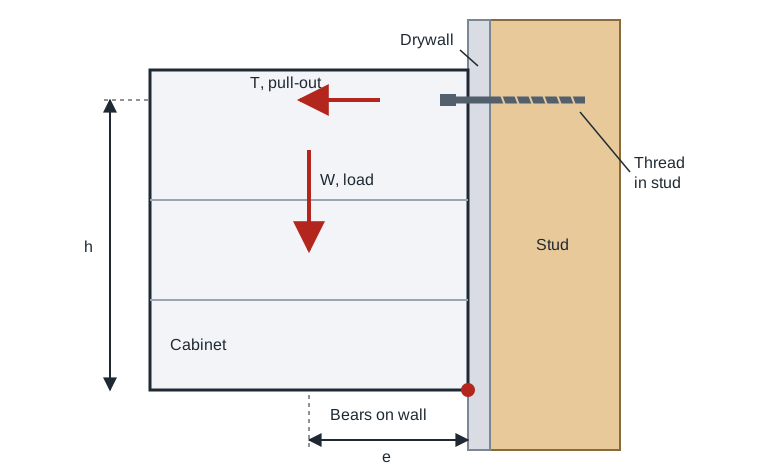
Do the arithmetic for a cabinet at the top of the ratings in the table, 200 lb of contents in a 12 in deep cabinet, with the top screws 28 in above its bottom edge.
Shear. Four screws share the weight: 200 / 4 = 50 lb per screw, straight down.
Pull-out. Spread evenly, the load acts at half the depth, 6 in from the wall. The top row resists the overturning moment: T = 200 x 6 / 28 = 43 lb for the whole top row, about 21 lb per screw if two screws are in it.
So a cabinet loaded to its rating asks each top screw for roughly 50 lb down and 21 lb out. Heavy items at the front raise e, and a shorter cabinet lowers h; either raises T in direct proportion.
What one screw in a stud holds
The Wood Handbook gives the maximum withdrawal load of screws in the side grain of seasoned wood as:
- Wood screws:
p = 15,700 x G^2 x D x L - Lag screws:
p = 8,100 x G^1.5 x D^0.75 x L
where p is in pounds, G is the wood's specific gravity, D is the shank diameter in inches and L is the length of thread in the wood. Studs are not one species. The handbook's tables put white spruce at G = 0.36 and lodgepole pine at 0.41, both common in SPF studs, and coast Douglas-fir at 0.48. The tapping screws in cabinet kits withdraw about 10 percent better than wood screws, so the wood screw formula slightly understates them.
Those are maximum loads from short tests. The handbook says that one-sixth of the average maximum "has usually been accepted as the allowable load for long-time loading conditions." The last column applies that one-sixth to the weakest wood, which is the figure to hold the 21 lb demand against.
| Fastener, 1/2 in drywall | Thread in stud | Maximum, white spruce (G 0.36) | Maximum, coast Douglas-fir (G 0.48) | One-sixth, white spruce |
|---|---|---|---|---|
| 5/16 x 1-1/2 in lag | 1 in | 731 lb | 1,126 lb | 122 lb |
| #10 x 2-1/4 in screw | 1-3/4 in | 673 lb | 1,196 lb | 112 lb |
| 1/4 x 2-1/2 in, lag formula | 2 in | 1,237 lb | 1,905 lb | 206 lb |
| #10 x 3 in screw | 2-1/2 in | 966 lb | 1,718 lb | 161 lb |
Read down the one-sixth column. The 5/16 in lag, the biggest fastener here, holds no better than a #10 screw, because it has barely an inch of wood. The 1/4 x 2-1/2 in screw beats them by 69 and 84 percent, and its edge comes from length, not diameter. Every row clears the 21 lb demand several times over, which is the other half of the answer: when a cabinet comes off a wall, the screw size is rarely why.
The design values in our overhead rack guide, about 205 lb per inch for a 5/16 in lag in SPF under the National Design Specification, come from a different method and reach the same conclusion.
Shear tells the same story. The handbook's lateral formula for wood screws in softwood up to G 0.42 gives about 121 lb for a #10 at the proportional limit, with an ultimate load about four times that, as long as the screw reaches seven diameters into the wood, 1-1/3 in for a #10. That formula assumes the cabinet bears directly on wood. Drywall in between is a gap the screw spans in bending, so read 121 lb as a ceiling against the 50 lb demand, not as a guarantee.
How cabinets actually come off the wall
If one screw holds several times the demand, falls have other causes.
A screw that missed the stud. Three screws in wood and one in drywall leaves three screws doing the work of four, and one of them is usually a top screw, carrying the pull-out. Gladiator spaces the back holes of its welded cabinets 8 in apart for stud mounting; check that yours land before you drill.
A screw too close to the edge of the stud. A stud face is 1-1/2 in wide. The handbook sets lag screw edge distances by the bolt rules, and for a bolt bearing along the grain, which is how a cabinet loads a vertical stud, the center must sit at least 1.5 diameters from the edge. That leaves very little room:
| Fastener | Minimum edge distance | Allowed miss from stud center |
|---|---|---|
| 1/4 in lag | 0.38 in | 3/8 in |
| 5/16 in lag | 0.47 in | just over 1/4 in |
The bigger fastener is the less forgiving one to place.
No pilot hole, or the wrong one. For lag screws the handbook calls for a hole the size of the shank through the unthreaded part, and for the threaded part 40 to 70 percent of the shank diameter in low-density softwoods, 60 to 75 percent in Douglas-fir and Southern Pine. For a 5/16 in lag that is roughly 3/16 in, the same bit Kobalt specifies for the 8 mm lags on its shelf brackets. For wood screws in softwood the handbook uses a hole about 70 percent of the thread's root diameter, which for a #10 is near 3/32 in. Everest calls for a 5/16 in pilot without stating its screw's size, so check the supplied screw first: the pilot must be smaller than the root of the thread.
Stripped by the driver. An impact driver will spin a screw past seated in a softwood stud, stripping its thread. The thread is then pulling against crushed fiber, and no calculation above applies. Seat lag screws with a wrench, as Gladiator's instructions do with a 1/2 in wrench, and stop tapping screws when the washer is tight.
Overloaded, often by a lot. Ratings run from 100 to 200 lb a cabinet. A row of sockets or fastener bins exceeds that faster than it looks. Everest's 200 lb is an evenly distributed figure, not "anything that fits". The gap between a printed rating and the limit that actually binds is the same one covered in tool box load capacity.
Rails, cleats and stacked cabinets
On a rail or cleat, the rail's screws carry everything.
- Husky Track is rated 100 lb per linear foot, takes two screws per stud, and "must begin and end on studs." Husky allows a drywall anchor only where the end of a track overhangs its last stud by more than 2 in.
- Gladiator GearTrack and GearWall must have "mounting screws in every slot and at every stud location with a maximum of 24 in" horizontally between screws before a cabinet goes on them.
- A shop-made French cleat follows the same rule. Every stud it crosses gets a screw, and the cleat's thickness comes off the screw's length. The wall system comparison covers cleat geometry and load per foot.
A rail also adds its own thickness behind the cabinet. Through a 3/4 in rail and 5/8 in drywall, reaching 1-3/4 in of thread in the stud takes a screw of at least 3-1/8 in, so buy 3-1/2 in.
Mounting several cabinets in a run, or one above another, multiplies the load on each stud. Kobalt's manual says that when mounting multiple units to a wall you should "check local building codes or consult with a contractor to determine the maximum load rating for your desired installation." For where a run of wall cabinets fits relative to benches and doors, see garage shop layout.
Concrete and block walls
NewAge and Kobalt give the same masonry alternative: four 1/4 x 2-1/4 in concrete screws, or #10 x 2 in screws in 3/16 in masonry plugs, drilled with a hammer drill. Husky offers concrete screws, or 2x2 furring anchored at 16 in on center with plywood over it for heavier storage. Furring also gives a damp wall an air gap, the same reason pegboard goes on furring strips. None of the withdrawal figures above apply to masonry; use the anchor maker's ratings.
Where this answer stops applying
- Steel studs. Every number here is for wood. None of the eight manuals reviewed covers light-gauge steel framing, and a screw's grip in a thin steel flange has nothing in common with thread in a 2x4.
- Loads above the rating. The arithmetic above is for a cabinet at its printed rating. It does not license loading past it.
- Anything overhead. A cabinet on a wall loads its screws mostly in shear. A rack on a ceiling loads them entirely in withdrawal, which is a different and less forgiving problem, covered in overhead racks and shelving.
Installation checklist
- Measure the drywall thickness and anything else behind the cabinet. Add 1-3/4 in for the stud and round the screw length up.
- Find every stud with a stud finder, then confirm each hole location with a nail or small bit.
- Use four fasteners per cabinet, in at least two studs, with the washers the manual specifies.
- Drill the pilot to the handbook's percentage: about 3/16 in for a 5/16 in lag in softwood, about 3/32 in for a #10 screw.
- Seat lags with a wrench. Stop driven screws at snug.
- Load heavy items low and toward the back, which shortens the lever arm e. It is the same moment balance that decides whether a roller cabinet tips.