Key takeaways
- DeWalt's DWS779 manual says "Never use a smaller diameter blade. It will not be guarded properly." Bosch says not to use a blade "larger or smaller than 12" diameter", and Makita says to use only the diameter marked on the tool.
- Speed is not what fails. A Diablo 10 in blade is rated 6,000 rpm, well above the 3,200 to 4,000 rpm these saws run. The diameter rule fails, the same way a smaller wheel on a bigger grinder does.
- The arbor often fails first. Diablo's 10 in blades have a 5/8 in bore, and the Bosch GCM12SD and Makita LS1219 take only a 1 in bore. DeWalt's DWS779 and Milwaukee's 2739 accept 5/8 in.
- A blade turns at the saw's rpm whatever its size. On a 3,800 rpm DWS779 the rim of a 12 in blade moves at 11,938 feet per minute and a 10 in blade's at 9,948.
- The 10 in blade loses an inch of reach. Bosch lists a replacement blade "less than 12" diameter" as the cause when the blade does not cut completely through the workpiece.
The question keeps coming back because two true facts get joined into a false one. 10 in miter saws do run faster than 12 in saws, and a 10 in blade with a 5/8 in bore will slide onto some 12 in saws. Neither makes the swap faster or allowed. The speed belongs to the saw, and the manuals rule the swap out by diameter.
What the four manuals say, word for word
Each maker prints the blade rule in its own words. None of them leaves room for a smaller blade:
| Saw | The blade rule, quoted |
|---|---|
| DeWalt DWS779 | "ALWAYS USE 12" (305 mm) SAW BLADES WITH EITHER 1" (25.4 mm) OR 5/8" (15.88 mm) ARBOR HOLES. SPEED RATING MUST BE AT LEAST 4800 RPM. Never use a smaller diameter blade. It will not be guarded properly." |
| Bosch GCM12SD | "To avoid injury, do not use a blade larger or smaller than 12" diameter and 1" arbor." And: "use saw blade rated 3800/min (RPM) or greater." |
| Makita LS1219 | "Only use the saw blade with the diameter that is marked on the tool or specified in the manual. Use of an incorrectly sized blade may affect the proper guarding of the blade or guard operation which could result in serious personal injury." |
| Milwaukee 2739 | "Use only 12" sliding miter saw blades rated at least 5000 RPM." |
DeWalt and Makita name the reason as well as the rule: the guard. Bosch prefaces its rule with "To avoid injury", and Milwaukee states the size without a reason.
Diameter, arbor, speed and blade rating, side by side
Here are the four saws on the numbers that decide a blade swap, all from the makers' own manuals and product pages:
| Saw | Blade diameter | Arbor | No-load speed | Blade rating required |
|---|---|---|---|---|
| DeWalt DWS779 | 12 in (305 mm) | 1 in or 5/8 in | 3,800 rpm | 4,800 rpm minimum |
| Bosch GCM12SD | 12 in | 1 in only | 4,000 rpm on the product page | 3,800 rpm minimum in the manual |
| Makita LS1219 | 12 in (305 mm) | 1 in (25.4 mm) | 3,200 rpm | At or above the speed marked on the tool |
| Milwaukee 2739 | 12 in | 5/8 in | 3,600 rpm | 5,000 rpm minimum |
Two of these numbers do not line up. Bosch's 2018 manual asks for a blade "rated 3800/min (RPM) or greater", while the current product page lists the saw at 4,000 rpm. A blade rated exactly 3,800 rpm would sit 5 percent below that. Read the nameplate on your saw and buy a blade rated at or above the higher number, which is Makita's rule stated generally: a speed "equal or higher than the speed marked on the tool."
The other two makers build in margin. DeWalt's 4,800 rpm minimum is 26 percent above the DWS779's 3,800 rpm, and Milwaukee's 5,000 rpm is 39 percent above the 2739's 3,600.
Speed passes, diameter fails
Now set real blades against those rules. Diablo publishes these ratings for its own 10 in and 12 in wood blades:
| Blade | Diameter | Arbor | Kerf | Max rpm |
|---|---|---|---|---|
| Diablo D1060X | 10 in | 5/8 in | .098 in | 6,000 |
| Diablo D1080X | 10 in | 5/8 in | .098 in | 6,000 |
| Diablo D1260X | 12 in | 1 in | .118 in | 6,000 |
| Diablo D1280X | 12 in | 1 in | .118 in | 5,000 |
Check a 10 in Diablo against each saw the way the manuals ask:
| Check | DeWalt DWS779 | Bosch GCM12SD | Makita LS1219 | Milwaukee 2739 |
|---|---|---|---|---|
| Speed: 6,000 rpm against the requirement | Passes (4,800) | Passes (3,800, or 4,000 on the page) | Passes (3,200) | Passes (5,000) |
| Arbor: 5/8 in bore | Fits | Does not fit a 1 in arbor | Does not fit a 1 in arbor | Fits |
| Diameter: 10 in against 12 in | Fails | Fails | Fails | Fails |
The speed row always passes. The arbor row fails on two of the four saws, since a 5/8 in bore cannot go over a 1 in arbor. On the DeWalt and the Milwaukee the blade goes on, and the diameter rule is the only thing left to stop it.
This is the same pattern as a 4-1/2 in cut-off wheel on a 5 in grinder: the smaller accessory clears the speed check with room to spare, and the guard built around the bigger one decides the answer.
Why "a 10 inch blade spins faster" is a misreading
The claim starts with saws, not blades. Tyler Brown's 10 in versus 12 in comparison puts it as "A 10-inch miter saw with a 15 amp motor will typically provide a speed of 5000 RPMs, whereas the larger blade size of 12-inches will have 4000 RPMs." That part matches the makers: DeWalt lists its 10 in DWS713 at 5,000 rpm and its 12 in DWS779 at 3,800. The same guide then says "With the power of the motor being the same, the 10-inch blade will produce higher RPMs." That sentence is about two different saws. Read as advice about blades, it goes wrong.
On one saw, the motor sets the arbor speed and the blade is clamped to the arbor, so a 10 in blade on a DWS779 turns at 3,800 rpm, the same as the 12 in blade it replaced. What changes is how fast the teeth move.
Rim speed in feet per minute is the circumference in feet times rpm:
rim speed (ft/min) = 3.1416 x diameter (in) / 12 x rpm
Worked for the DWS779: a 12 in blade at 3,800 rpm gives 3.1416 x 12 / 12 x 3,800 = 11,938 ft/min. A 10 in blade at the same 3,800 rpm gives 3.1416 x 10 / 12 x 3,800 = 9,948 ft/min. Multiply by 0.00508 for meters per second.
| Saw and speed | 12 in blade rim speed | 10 in blade rim speed | Difference |
|---|---|---|---|
| Makita LS1219, 3,200 rpm | 10,053 ft/min (51.1 m/s) | 8,378 ft/min (42.6 m/s) | 1,676 ft/min slower |
| Milwaukee 2739, 3,600 rpm | 11,310 ft/min (57.5 m/s) | 9,425 ft/min (47.9 m/s) | 1,885 ft/min slower |
| DeWalt DWS779, 3,800 rpm | 11,938 ft/min (60.6 m/s) | 9,948 ft/min (50.5 m/s) | 1,990 ft/min slower |
| Bosch GCM12SD, 4,000 rpm | 12,566 ft/min (63.8 m/s) | 10,472 ft/min (53.2 m/s) | 2,094 ft/min slower |
The ratio is fixed at 10 divided by 12, so on every saw the 10 in blade's teeth move 16.7 percent slower. The rpm is identical. Only the rim slows.
What the "faster" claim really describes is a 10 in blade on a 10 in saw: 3.1416 x 10 / 12 x 5,000 = 13,090 ft/min on a DWS713, faster than a 12 in blade on any saw above. Move the blade to a 12 in saw and the speed stays behind.
What the missing inch does
A 10 in blade is 1 in (25.4 mm) smaller in radius than the 12 in blade the saw was built around. That inch comes off everywhere at once.
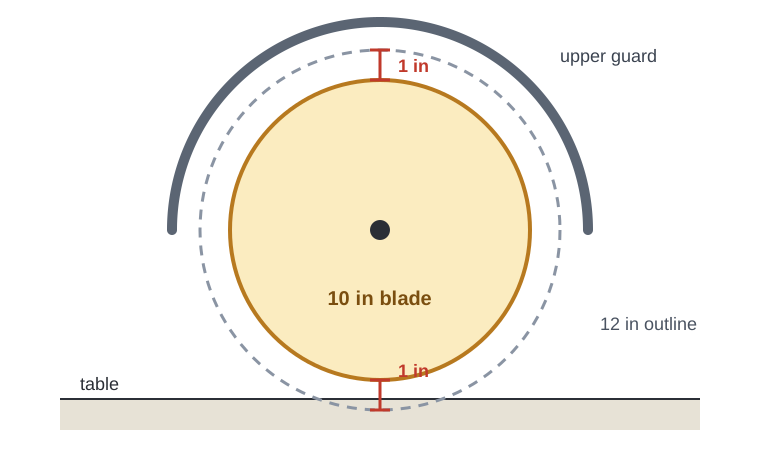
At the guard. The guard is sized for a 12 in blade, so a 10 in blade sits inside it with an extra inch all round. That is the condition DeWalt's "will not be guarded properly" and Makita's "may affect the proper guarding of the blade or guard operation" describe.
At the table. The blade's lowest point is 1 in higher at full plunge. Bosch's troubleshooting chart for the GCM12SD lists "Blade does not cut completely through workpiece" with the cause "Replacement blade is less than 12" diameter" and the fix "Change to a blade that is fully 12" diameter." The Fine Woodworking thread reached the same place: "The cut may not reach to the fence /table corner."
In capacity. The thread's answer was to build up the fence, and a later reply added that this "will reduce the capacity." It also leaves the guard where it was, so it fails the diameter rule all the same.
What the forum thread actually asked
The Fine Woodworking thread is often cited as a yes. Read in full, it is a question about cut quality. The original poster had a 1 in arbor 12 in chop saw, was "not getting a smooth, straight cut", and wanted a smaller blade because of "a flex/vibration thing." The replies pointed elsewhere: thin kerf blades "can have a tendency to flex", high tooth count blades of 80 are "more prone to this than 60s", and "Arbor bearings wear out and it won't matter what size or type of blade you use." The thread ends on blade brand recommendations.
So the thread is a diagnosis, not a green light: the fixes it points to are a different blade or the saw's bearings. And the poster's saw had a 1 in arbor, which a 5/8 in bore 10 in blade like Diablo's would not have mounted on.
Kerf and plate limits still apply to a 12 in blade
Swapping between 12 in blades has its own limits, and they are printed:
| Saw | Thickness limit |
|---|---|
| Bosch GCM12SD | 0.100 in maximum plate thickness |
| Makita LS1219 | 3.2 mm (1/8 in) maximum kerf |
| Milwaukee 2739 | 1/8 in maximum kerf |
Diablo's 12 in blades listed here have a .118 in kerf, inside the Makita and Milwaukee 1/8 in (0.125 in) limit, and plates of .071 in (D1260X) and .087 in (D1280X), both under Bosch's 0.100 in. DeWalt's DWS779 manual adds a blade type rule: "Use crosscut blades only! Do not use blades designed for ripping, combination blades or blades with hook angles in excess of 7°." Diablo lists the D1260X as a combination blade with a 15 degree hook, so it is the right size and still the wrong blade for a DWS779. The D1280X, an 80 tooth Hi-ATB blade with a 7 degree hook, is not in excess of 7 degrees and is rated 5,000 rpm, above the 4,800 DeWalt asks for.
Where this answer stops applying
- Other saws. The four saws here are the ones whose manuals were read. Saws from other makers carry their own rule, and the nameplate and manual on yours govern. Every manual checked here specifies the full 12 in diameter.
- Other 12 in blades. Nothing in this page argues against any 12 in blade that meets the saw's arbor, speed, kerf and type rules. The Diablo ratings here are examples, and the marking on your blade overrides them.
- 10 in saws. A 10 in blade on a 10 in saw is the configuration it was built for, at that saw's own speed rating. Nothing here applies to it.
- Thin kerf and cut quality. Whether a thinner or lower tooth count 12 in blade cuts cleaner on a given saw is not a published specification and is not settled here.
Storing blades by diameter and bore
Keep 10 in and 12 in blades apart, labeled by diameter and bore, and the question does not come up at the saw. For hanging them, French cleats, pegboard, slatwall and track walls compares what each will hold. The labeling method in shadow boards, labels and tool inventory control works for a blade rack as well as for wrenches. Carbide teeth sit on a steel plate, and the humidity control in rust prevention in tool storage applies to blades left in a cold garage.
Keep the blade rack in the same zone as the saw, so the right size is the nearest one, as laid out in garage shop layout. DeWalt and Bosch list the DWS779 and GCM12SD with 15 A motors, which puts them in the 12 to 16 A band of the cord tables compared in what gauge extension cord a 15 amp tool needs.
The thirty-second check
- Read the blade diameter on the saw or in its manual. On all four saws here it is 12 in, with no smaller size allowed.
- Match the bore to the arbor: 1 in on the Bosch GCM12SD and Makita LS1219, 5/8 in on the Milwaukee 2739, either on the DeWalt DWS779.
- Check the blade's max rpm against the saw's requirement: 4,800 on the DWS779, 5,000 on the 2739, at or above the nameplate speed on the others.
- Check kerf, plate and blade type against the manual's limits.
- If cuts are rough with a 12 in blade, change the 12 in blade or have the bearings checked. A 10 in blade turns at the same rpm with its teeth moving about 17 percent slower, and it fails the diameter rule in every manual here.