Key takeaways
- Weiler and Milwaukee both rate their 4-1/2 in .045 in Type 1 cut-off wheels at 13,300 rpm. The fastest grinder checked here runs 12,000 rpm, so a 4-1/2 in wheel clears every one of them on speed.
- The guard is the limit. Milwaukee's manual says "Guard size must match wheel size" and DeWalt's says to use "the specific guard designed for the selected wheel". A 5 in guard around a 4-1/2 in wheel is the wrong guard.
- A cut-off wheel also needs a cut-off guard. DeWalt requires a Type 1/41 guard for Type 1 and 41 wheels, and its manual lists that guard at extra cost except on the DWE43144 models.
- Fitting the spindle proves nothing. The 4-1/2, 5 and 6 in wheels here all have a 7/8 in arbor hole and every grinder here has a 5/8-11 spindle, which is why DeWalt warns that an accessory that attaches "does not assure safe operation".
- The reverse swap fails on speed. A 6 in wheel is rated 10,200 rpm, below every 10,500 to 12,000 rpm grinder here, even after it wears down to 4-1/2 in.
Most answers stop at the spindle: both wheels have a 7/8 in arbor hole, so the small wheel goes on. DeWalt's manual rules that test out by name: "Just because the accessory can be attached to your power tool, it does not assure safe operation." Two other checks decide the swap. The speed marked on the wheel always passes for a smaller wheel. The guard fails unless you change it.
The two checks that actually decide it
Every grinder manual checked here, and the federal rule for workplaces, comes back to the same two tests:
| Test | DeWalt manual | Milwaukee manual | OSHA |
|---|---|---|---|
| Speed | "The rated speed of the accessory must be at least equal to the maximum speed marked on the power tool." | Use wheels "rated at or above the RPM listed on the tool's nameplate." | Spindle speed "shall be checked before mounting of the wheel to be certain that it does not exceed the maximum operating speed marked on the wheel." |
| Size and guard | Diameter and thickness "within the capacity rating of your power tool," with "the specific guard designed for the selected wheel." | "Guard size must match wheel size. For example, use 4 1/2" guard only with 4 1/2" wheel." | Right angle head grinders: 180 degree maximum exposure, with the guard "between the operator and the wheel during use." |
The OSHA wording is from 1910.243(c), the portable tool section, which repeats the speed check in 1910.215(d)(1).
Wheel speed ratings against grinder speeds
Cut-off wheels carry a maximum rpm, and it falls as the diameter grows. Two makers' published ratings for thin .045 in Type 1 wheels:
| Wheel diameter | Weiler Tiger, max rpm | Milwaukee, max rpm |
|---|---|---|
| 4-1/2 in | 13,300 | 13,300 |
| 5 in | 12,200 | 12,250 |
| 6 in | 10,200 | 10,200 |
And the grinders, from three makers' own specification pages and manuals:
| Grinder | Rated wheel size | No-load speed | Guard in the box |
|---|---|---|---|
| DeWalt DWE402 | 4-1/2 in | 11,000 rpm | 4-1/2 in Type 27 |
| Makita 9557PB | 4-1/2 in | 11,000 rpm | 4-1/2 in |
| Makita 9564PC | 4-1/2 in | 10,500 rpm | 4-1/2 in |
| Milwaukee 6142-30 | 4-1/2 in (max capacity 4-1/2 x 1/4 in) | 12,000 rpm in the manual, 11,000 on the product page | Type 27 |
| Makita GA5052 | Sold as 4-1/2 in / 5 in, wheel diameter listed 5 in | 11,000 rpm | 5 in |
| Makita 9565CV | 5 in | 2,800 to 10,500 rpm | 5 in |
Milwaukee's manual and product page disagree on the 6142. The checks below use the manual's higher 12,000 rpm, and the nameplate on your tool overrides both.
Now set each wheel against each speed. The margin is how far the wheel's rating sits above the grinder's speed:
| Wheel (rating) | 10,500 rpm grinder | 11,000 rpm grinder | 12,000 rpm grinder |
|---|---|---|---|
| 4-1/2 in (13,300) | +26.7%, passes | +20.9%, passes | +10.8%, passes |
| 5 in (12,200) | +16.2%, passes | +10.9%, passes | +1.7%, passes |
| 6 in (10,200) | -2.9%, fails | -7.3%, fails | -15.0%, fails |
A 4-1/2 in wheel has at least a 10 percent margin on every grinder listed, and more than 20 percent on the 11,000 rpm 5 in Makita GA5052. The 6 in row is the swap that fails, on every grinder here.
The rim speed arithmetic behind the ratings
The ratings fall with diameter in step with rim speed. Rim speed in surface feet per minute is the circumference in feet times rpm, and m/s is sfpm times 0.00508:
sfpm = 3.1416 x diameter (in) / 12 x rpm
| Wheel at its rated rpm | Arithmetic | Rim speed | In m/s |
|---|---|---|---|
| 4-1/2 in at 13,300 | 3.1416 x 4.5 / 12 x 13,300 | 15,669 sfpm | 79.6 |
| 5 in at 12,200 (Weiler) | 3.1416 x 5 / 12 x 12,200 | 15,970 sfpm | 81.1 |
| 5 in at 12,250 (Milwaukee) | 3.1416 x 5 / 12 x 12,250 | 16,035 sfpm | 81.5 |
| 6 in at 10,200 | 3.1416 x 6 / 12 x 10,200 | 16,022 sfpm | 81.4 |
All three sizes are rated to about the same rim speed, close to 16,000 sfpm (80 m/s). Run the arithmetic the other way and the grinder's speed puts the rim of each wheel here:
| Wheel on an 11,000 rpm grinder | Rim speed | Share of its rated rim speed |
|---|---|---|
| 4-1/2 in | 12,959 sfpm | 83% |
| 5 in | 14,399 sfpm | 90% |
| 6 in | 17,279 sfpm | 108% |
On an 11,000 rpm grinder, a 4-1/2 in wheel's rim travels 1,440 sfpm slower than a 5 in wheel's. A smaller wheel on the same spindle is further inside its rating, not closer to it.
Why the guard decides it
A 5 in grinder's guard is built around a 5 in wheel. Fit a 4-1/2 in wheel under it and the wheel's radius shrinks by a quarter inch, from 2.5 in to 2.25 in, while the guard stays where it was.
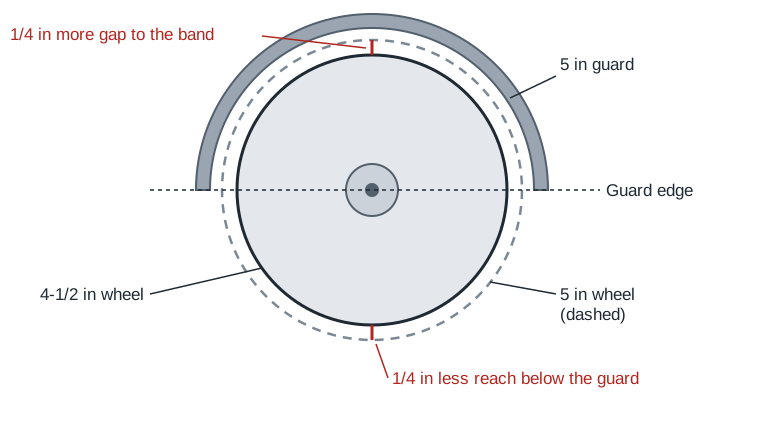
The rules. Milwaukee's sentence covers it directly, and DeWalt's manual gives the reason: "Wheels for which the power tool was not designed cannot be adequately guarded and are unsafe." Its accessories chart adds "Always use the smallest proper guard possible that does not contact the accessory." For a 4-1/2 in wheel, the smallest proper guard is a 4-1/2 in one.
The geometry. A quarter inch of lost reach is a quarter inch less depth of cut below the guard edge. Taking the guard off to win it back fails Weiler's test of a wheel that fits "without interfering with or removing the guard", and OSHA's guard requirement with it.
The fix is a part number. Makita lists a separate 4-1/2 in guard for its small grinders, and the GA5052, sold as a 4-1/2 in / 5 in grinder, ships with only the 5 in guard. Makita also lists a "4-1/2" - 5" Dust Extraction Cutting Guard" as an accessory for the 9564PC and 9565CV, which is a guard the maker sells for both sizes. Where the grinder's maker lists a guard for the size you are fitting, use it. Where it does not, the swap is not covered by the manual.
A cut-off wheel needs a cut-off guard
The size of the guard is half of it. The type is the other half. The guards in the box are usually for grinding. DeWalt's DWE402 page lists a 4-1/2 in One-Touch Type 27 guard in the box, and Milwaukee's 6142-30 ships with a Type 27 guard.
DeWalt's manual is specific about cut-off work:
- "A Type 1 guard must be used for any wheel where surface grinding is forbidden."
- "Cutting can also be performed by using a Type 41 wheel and a Type 1 guard."
- Type 1/41 guards "are intended for use with Type 1/41 cutting wheels and Type 27 wheels marked for cutting only."
- The Type 1/41 guard "is available at extra cost," and is included with the DWE43144 and DWE43144N.
Makita lists the cut-off parts by size too: a 4-1/2 in clip-on cut-off wheel guard cover (199709-0), a 5 in cover (199710-5) and a 5 in cut-off wheel guard (122641-3). So the full answer for a flat 4-1/2 in Type 1 cut-off wheel on a 5 in grinder is a 4-1/2 in guard set up for cutting: a Type 1/41 guard on a DeWalt, or the 4-1/2 in cut-off parts the maker lists for your grinder.
What OSHA actually requires, and what it does not
For a workplace, two sections of 29 CFR 1910 apply, and they are often quoted out of place.
1910.243(c) covers handheld grinders. Right angle head grinders, the class every angle grinder here belongs to, get a guard with "a maximum exposure angle of 180°," placed between the operator and the wheel and adjusted so "pieces of an accidentally broken wheel will be deflected away from the operator." It also requires the spindle speed to be checked against the speed marked on the wheel before mounting.
1910.215 covers fixed machinery. Its exposure angles, such as 90 degrees for bench grinders and 150 for cutting-off machines, are not for handheld grinders.
The 1/16 in clearance is not about cut-off wheels. Both sections set a one-sixteenth inch maximum between wheel and guard, but only for "revolving cup guards" that mount behind cup wheels (Types 6 and 11) and turn with them. No such figure applies to a Type 1 wheel on an angle grinder, and DeWalt bans Type 11 wheels on these grinders anyway.
One 1910.215 figure does apply to the swap: Type 1 cutting-off wheels go between relieved flanges "at least one-fourth the wheel diameter." That is 1.125 in for a 4-1/2 in wheel and 1.25 in for a 5 in wheel. A flange that meets the larger figure meets the smaller one, so the grinder's own flanges are not the obstacle when you go down a size. DeWalt also notes that "Flanges for cut-off wheels may be different from grinding wheel flanges", so use the flange arrangement its chart shows for cutting wheels.
The reverse swaps, and the worn wheel trap
The same two checks settle the swaps people ask about next:
| Swap | Speed check | Guard and capacity check | Verdict |
|---|---|---|---|
| 4-1/2 in wheel on a 5 in grinder | Passes, 13,300 rpm against 11,000 or less | Needs a 4-1/2 in guard, or a guard the maker lists for both sizes | Yes, with the guard changed |
| 5 in wheel on a 4-1/2 in grinder | Passes on paper, 12,200 against 12,000 at the tightest | Over capacity: DeWalt's diameter rule, Milwaukee's 4-1/2 in max | No |
| 6 in wheel on a 4-1/2 or 5 in grinder | Fails, 10,200 against 10,500 to 12,000 | Over capacity | No |
| 6 in wheel worn to 4-1/2 in | Fails, still marked 10,200 | Fits the guard, which is the trap | No |
The last row is where rim speed arithmetic misleads. A 6 in wheel worn to 4-1/2 in, at 11,000 rpm, has a rim speed of 12,959 sfpm, well under the 16,022 sfpm its rating works out to when new. The rules still say no. DeWalt: "Do not use worn down wheels from larger power tools. Wheel intended for larger power tool is not suitable for the higher speed of a smaller tool and may burst." And OSHA's check is against "the maximum operating speed marked on the wheel," which on that wheel is still 10,200 rpm. The mark governs, not a rim speed you work out yourself.
Storing guards and wheels together
The swap is easy to get right when each size's guard, cover and flanges live in the same drawer as its wheels, labeled by diameter. The method in shadow boards, labels and tool inventory control works for guards as well as for wrenches, and small parts storage covers the bins and cases that keep loose flanges and lock nuts from going missing.
Wheels age in storage, so the speed mark is not the only thing to read on the ring. The use-by month is stamped there as well, and how to read it, and why damp storage weakens resin wheels, is worked out in whether cut-off wheels expire. Keep spares in the consumables zone rather than by the grinding station, as laid out in garage shop layout, and not loose in a truck box, where condensation soaks a sleeve of wheels without a leak.
An 11 A corded grinder falls in the 10 to 12 A band of the manufacturer cord tables compared in what gauge extension cord a 15 amp tool needs, so that is the band to read, not the 15 A one.
Where this answer stops applying
- Other grinders. The speeds here are the listed models'. Read the nameplate on yours. A grinder above 13,300 rpm would fail even a 4-1/2 in wheel; none in this table comes close.
- Other wheels. The ratings are for .045 in Type 1 wheels from Weiler and Milwaukee. Thicker wheels, Type 27 wheels and diamond blades carry their own marked speeds. The wheel's own label overrides this page.
- Cordless grinders. Battery grinders sold as 4-1/2 in to 5 in are not in the table. The same two checks apply: the marked rpm against the tool's maximum speed, and the guard the tool's manual lists for the wheel size.
- Guards from another maker. A guard sold for a different grinder is not, in the manuals' wording, "the specific guard designed for the selected wheel" on yours. Use one the maker of your grinder lists for it.
The thirty-second check
- Read the maximum rpm on the wheel and the maximum speed on the grinder's nameplate. The wheel's number must be equal or higher. A 4-1/2 in wheel at 13,300 rpm passes on any grinder in this table.
- Fit the guard made for the wheel's diameter. A 5 in guard around a 4-1/2 in wheel is the wrong guard.
- For a flat Type 1 or 41 cut-off wheel, use the cut-off guard or clip-on cover, not the open Type 27 grinding guard.
- Never run a worn wheel from a bigger grinder. Its marked rpm, not its present diameter, is its rating.
- Then do the manufacturer's run test: DeWalt says to stand clear of the wheel's plane and run it at maximum no-load speed for one minute.