Key takeaways
- NFPA 30 section 9.5.4 says storage cabinets are not required to be vented for fire protection, and its annex says venting is not recommended for fire protection.
- An unvented cabinet must have its vent openings sealed with the maker's bungs. A vented one must be ducted to a safe place outdoors. A bung left open to the room meets neither rule.
- Justrite ships 2 in NPT vent bungs only for customers whom the EPA or other laws require to vent, and advises leaving them plugged.
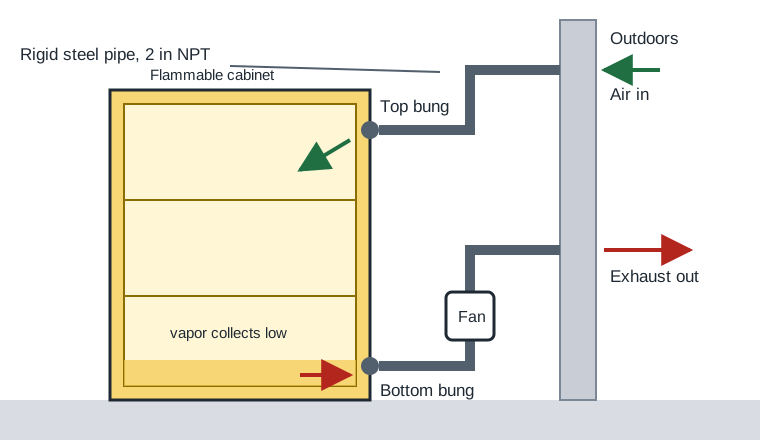
- Where venting is required, exhaust from the bottom bung and supply air to the top, through rigid steel pipe, under suction from an explosion-proof fan that stops in a fire.
- In a sealed cabinet, two legal 5 gal gas cans may emit up to 3 g of vapor a day, and about 1.8 g brings a cubic foot of air to gasoline's lower explosive limit.
Two answers circulate. One says vent it, because the cabinet came with two vent openings and flame arresters, so venting must be the point. The other says never vent. The second is closer, but misses the case where venting is required. NFPA 30 gives a cabinet two allowed states: sealed with its bungs, or ducted outdoors. Bungs unscrewed so the cabinet breathes into the room is neither. Below, OSHA, NFPA 30, the fire code, two cabinet makers and two university safety offices are set side by side.
What each rulebook says about venting
OSHA and the fire code say how a cabinet must be built and nothing about vents. NFPA 30 has the venting rule. The makers and safety offices say how to do it.
| Document | Is venting required? | If not vented | If vented |
|---|---|---|---|
| OSHA 29 CFR 1910.106(d)(3) | Not mentioned | Not mentioned | Not mentioned |
| Fire code 5704.3.2 (California edition) | Not mentioned in the cabinet section | Not mentioned | Not mentioned |
| NFPA 30, current 9.5.4 | Not required for fire protection purposes | Openings sealed with the maker's bungs | Ducted directly to a safe location outdoors or to a treatment device for flammable vapor, in a manner acceptable to the authority having jurisdiction (9.5.4.2) |
| NFPA 30, earlier 6.3.4, as quoted by UC Davis | "Not required to be vented for fire protection purposes" | "Sealed with the bungs supplied or with bungs specified by the manufacturer" | Vented outdoors or to a fume hood exhaust duct, without compromising the cabinet |
| Justrite technical note | Does not recommend venting | Leave vents plugged | 2 in NPT rigid steel pipe, explosion-proof blower under suction, engineer's design |
| UC Davis Fire Department | Not required or recommended | Bungs in | Rigid metal pipe, bottom exhaust, top inlet, 25 ft maximum run, no manifolds |
Every source that addresses the third column agrees: the unvented cabinet is sealed. Every source in the last column agrees too: a vented cabinet is connected to something that carries vapor out of the building. Nothing allows an open hole into the room. NFPA 30's annex, as the 2015 DCHAS-L discussion summarizes it, says venting is not recommended for fire protection but may be required for other reasons, meaning health and safety.
Why the cabinet has vents at all
Justrite's technical note on cabinet venting says it "supplies each Safety Cabinet with the 2" NPT vent bungs" and that those bungs "are for our customer's convenience, when the EPA, or other laws mandate venting." The same note says Justrite, "like NFPA 30, does not recommend venting of Safety Cabinets and advices customers to leave vents plugged unless venting is required."
So the openings are a fitting for users made to vent by some other rule: a building owner, a lab safety office, an environmental rule or a local fire official. For everyone else they are plugs.
Eagle's product sheet for its Space Saver cabinets, published by Justrite, describes them as including "dual vents with flame arresters." The arrester is not a third option between sealed and ducted. The DCHAS-L summary notes that NFPA 30 does not reference flame arresters for this use, and UC Davis leaves the arrester screens in place when a cabinet is ducted. It is extra protection on a vented cabinet, not a stand-in for the duct.
Why a vent can make the cabinet worse
A flammable cabinet's job is to keep an outside fire from the liquids inside. OSHA defines it with a test: the cabinet must limit its internal temperature to no more than 325 F (163 C) during a 10 minute fire test. The construction that achieves it is spelled out alongside:
- Bottom, top, door and sides of at least No. 18 gage sheet steel, double walled with a 1-1/2 in (38 mm) air space.
- Joints riveted or welded.
- A three-point lock on the door, and a door sill raised at least 2 in (51 mm) above the bottom.
A vent is a hole straight through that double wall and its air space. UC Davis puts the result in one line: "An improperly vented cabinet could compromise the ability of the cabinet to protect its contents from a fire." It also warns that riveting or fastening into the cabinet may compromise its fire rating, so a correct vent threads into the bung opening.
A fan adds a second risk. Justrite says any blower "shut down in the event of a fire to avoid drawing hot air and flame into the cabinet," and that shut-off dampers may also be required. During a fire, the air a fan pulls in through every gap is the fire.
The option that fails both rules: bungs out, open to the room
Unscrewing the bungs so the cabinet breathes feels like ventilation, and the flame arrester is still there. Measure it against NFPA 30:
- Is it unvented? No. An unvented cabinet has its openings sealed with the bungs supplied or bungs the maker specifies. These are open.
- Is it vented? Not in the code's sense. A vented cabinet is ducted directly to a safe location outdoors or to a treatment device (9.5.4.2). This one is ducted nowhere.
It also moves vapor to the worst place in a garage. Justrite notes that "flammable vapors are mostly heavier than air," so an open bottom bung lets them out at floor height. That is the zone the residential code keeps ignition away from: as covered in garage shop layout, a garage water heater or furnace must have its ignition source at least 18 in (457 mm) above the floor unless listed as flammable-vapor-ignition resistant. A cabinet beside it, bungs out, works against that rule.
What a sealed cabinet holds inside
A sealed cabinet of gas cans will not stay free of vapor, and is not designed to. UC Davis notes that cabinets "are designed to protect the internal contents from a fire outside the cabinet." The air inside is another matter. From the NIOSH Pocket Guide, gasoline's lower explosive limit is 1.4 percent by volume and its approximate molecular weight 110.
One cubic foot of air is 28.3 L. At the lower limit, 0.014 x 28.3 = 0.40 L of that is gasoline vapor. At 77 F (25 C) one mole of gas occupies about 24.5 L, so 0.40 / 24.5 = 0.016 mol, and 0.016 x 110 = 1.8 g of gasoline vapor per cubic foot.
Federal rules for portable fuel containers, 40 CFR 59.611, cap evaporative emissions at 0.3 g of hydrocarbons per gallon per day. Two full 5 gal cans at that ceiling may release 10 x 0.3 = 3 g a day.
| Free air inside the cabinet | Vapor at the lower explosive limit | Days for two 5 gal cans at the EPA ceiling to supply it |
|---|---|---|
| 2 cu ft | 3.6 g | 1.2 |
| 4 cu ft | 7.2 g | 2.4 |
| 8 cu ft | 14.4 g | 4.8 |
These are upper bounds: 0.3 g is a ceiling, cabinets are not airtight, and the vapor is lighter than the whole liquid's 110, so fewer grams fill the same space. The gas can vapor arithmetic for a truck box runs the same numbers in more detail. The direction is still clear: a sealed cabinet of fuel can hold a flammable mixture, and the exposure comes when the door opens. Manage that, not the bungs. UC Davis lists the steps to take before venting a cabinet to cut vapor:
- Place it cool, dry and out of direct sun, away from heat and ignition. Temperature swings increase vapor, and a garage in summer runs as hot as covered in tool battery storage temperatures.
- Keep room ventilation running, caps tight, container outsides clean and spills wiped at once.
- Inspect the cabinet and nearby metal for rust or corrosion, which UC Davis treats as a sign that vapor is high enough to need mechanical ventilation. It is the chemistry of rust prevention in tool storage with a worse cause.
If you have to vent: the requirements, assembled
If another rule makes you vent, the sources agree on how, and none treats it as a homeowner project. Justrite "recommends that our customers retain a professional engineer to design a vent system," and UC Davis requires engineering guidance. A design has to meet these:
- Confirm the requirement. Get it in writing from whoever imposes it, because NFPA 30 does not.
- Both bungs out, arresters in. UC Davis removes both metal bungs and keeps the flame arrester screens in the openings.
- Exhaust from the bottom, air in at the top. Justrite, UC Davis and the DCHAS-L summary all draw from the bottom bung, because the vapor is heavier than air, and supply make-up air to the top bung.
- Rigid steel, full size. Justrite's bungs take 2 in NPT threaded rigid steel pipe. UC Davis requires metal pipe at least equal to the cabinet's own construction, with an inner diameter no smaller than the opening, and rules out PVC and plastic because they cannot survive a fire.
- Thread it, do not fasten it. Riveting or screwing into the cabinet may compromise its rating (UC Davis).
- Suction, with the right fan. An explosion-proof blower pulling the cabinet under negative pressure, so leaks go into the cabinet rather than out of it. It must shut down in a fire, and dampers may be needed (Justrite). MSC describes thermally actuated dampers with fusible links that close in a fire.
- Outdoors, to a safe place. NFPA 30 9.5.4.2: directly to a safe location outdoors or to a treatment device for flammable vapor.
- Short and separate. UC Davis caps the total vent run at 25 ft and forbids manifolding vent pipe from several cabinets, and the DCHAS-L summary says the same about combining ducts.
Cabinet rules side by side: OSHA and the fire code
Venting aside, a buyer meets two rulebooks with slightly different texts.
| Requirement | OSHA 1910.106(d)(3) | Fire code 5704.3.2 |
|---|---|---|
| Capacity | 60 gal of Category 1, 2 or 3 liquids, or 120 gal of Category 4. OSHA's 2011 letter reads it as 120 gal total, no more than 60 gal of Class I and II | 120 gal (454 L) combined |
| Steel | No. 18 gage, double walled, 1-1/2 in air space | 0.044 in (1.12 mm), 18 gage, double walled, 1-1/2 in airspace; or listed to UL 1275 |
| Door | Three-point lock | Well fitted, self-closing, three-point latch |
| Bottom | Door sill raised at least 2 in | Liquid tight to at least 2 in |
| Fire performance | Internal temperature no more than 325 F in a 10 minute fire test | Through UL 1275 listing or the construction above |
| Label | "Flammable - Keep Fire Away" | The same words in red letters on a contrasting background |
| Venting | Not mentioned | Not mentioned |
Two rows matter when buying.
Self-closing doors. OSHA asks for a three-point lock; the fire code adds self-closing. Eagle sells the Space Saver with manual or self-closing doors, the latter held by fusible links that melt at 165 F (74 C) so the doors shut and latch in a fire. Where the fire code is enforced, buy self-closing.
The steel. The fire code's 0.044 in is a minimum, slightly under the 0.0478 in nominal thickness of 18 gauge set out in the steel gauge guide. A cabinet that quotes 18 gauge steel meets both texts on that row.
The fire code also raises the maximum allowable quantity of flammable liquid 100 percent where the excess is in cabinets complying with 5704.3.2, as Justrite's reference page quotes it.
Home garage: what actually applies
OSHA's standard is written for employers, and fire codes are adopted locally, so the edition that binds a private garage is a question for the fire marshal. The California edition of section 5704.3.4.4 allows "quantities not exceeding 10 gallons (38 L)" outside a cabinet "where in approved containers located in private garages or other approved locations." Two 5 gal cans reach that limit. A third can, or a shelf of solvents on top of them, is where a cabinet stops being optional under that text.
The venting answer is the same as in a plant: bungs in. A garage almost never has the engineered, outdoor-ducted exhaust NFPA 30 requires of a vented cabinet. Placement matters more: away from the water heater, out of direct sun, in the consumables zone the garage shop layout sets aside for it.
Where this answer stops applying
- Corrosive cabinets. Justrite's note treats them separately: vent pipe compatible with the chemical, still under suction. The fire rules here do not settle it.
- Open containers or dispensing. Everything above assumes closed containers. Ohio University refers cabinets with open containers to its safety office.
- A rule that requires venting. Then the duct is mandatory and the eight requirements above apply.
- Compressed gas. A flammable liquid cabinet is not a gas cylinder cabinet. Welding gases have their own rules, covered in storing oxygen and acetylene cylinders.
- Outside the US. Every rule here is American. Other countries' standards are not covered.