Key takeaways
- OSHA 1910.253 and 1926.350 both set 20 ft, or a noncombustible barrier at least 5 ft (1.5 m) high with a half-hour fire-resistance rating, between stored oxygen and fuel gas.
- A single oxygen and single acetylene cylinder on a purpose-built cart is treated as in use, not in storage, by OSHA's 2006 letters and by fire code section 3505.2.1. Every spare cylinder beyond that pair is storage.
- The fire code's partition must rise 18 in above the stored cylinders, so behind a 300 cu ft oxygen cylinder it is about 73 in tall, not 60.
- The fire code caps stored flammable gas at 1,000 cu ft per control area before sprinkler or cabinet increases, half of OSHA's 2,000 cu ft. That is two large acetylene cylinders.
- Supplier figures for standing a laid-down acetylene cylinder upright before use run from 30 minutes to 12 hours. Standing it overnight satisfies all of them.
Two answers circulate, and each is half right. One says oxygen and acetylene must always be 20 ft apart, which would rule out every oxy-acetylene welding cart. The other says the cart is fine, so the spares can sit beside it. The rule turns on one word, storage, which OSHA has defined in letters most guides never quote. Below, the OSHA standards, those letters, the fire code and three suppliers' data are set side by side and applied to a shop with one pair on a cart and a few spares.
What counts as storage
The separation rule only applies to cylinders "in storage". OSHA's general industry standard, 1910.253, and its construction standard, 1926.350, use the same separation text, but OSHA reads "storage" differently in each.
| Setting | When a cylinder is in storage | Source |
|---|---|---|
| General industry (shops, plants, fleet garages) | When it is not "in use" or "connected for use". The interval between uses does not matter | OSHA letter, May 10, 2006 |
| Construction | When it is "reasonably anticipated that gas will not be drawn from the cylinder within 24 hours" | OSHA letters, July 8, 1999 and May 8, 2006 |
| Fire code | A single oxygen and single fuel gas cylinder on a cart, connected to regulators and ready for service, may skip the separation | Fire code 3505.2.1 |
The construction test is the half-remembered "24 hour rule". OSHA's 1999 letter works through the end-of-day case: regulators off, caps on, cylinders secured upright on a cart, welding planned for next morning. Storage rules do not apply, because gas is expected to be drawn within 24 hours. The same letter covers the opposite case. Of the cylinders that arrive on a job ahead of the work, only those expected to be used within the next 24 hours escape the storage rules. The rest are storage.
The general industry reading is broader. OSHA's May 10, 2006 letter says a cylinder connected for use is not in storage however long it sits, because the 1910 standard is written around "in use or connected for use".
The cart exception, condition by condition
OSHA's May 8, 2006 letter sets four conditions for a pair on a cart, and the fire code adds its own list. A cart that meets both sets is the only arrangement where oxygen and acetylene can stand side by side.
| Condition | OSHA, May 8, 2006 | Fire code 3505.2.1 |
|---|---|---|
| How many | No more than one acetylene and one oxygen cylinder | A single oxygen and a single fuel gas cylinder |
| The cart | Designed to hold oxygen and acetylene upright, cylinders held by straps, chains or other securing devices | Cylinders secured to resist movement; cart meets the fire code's cart rules |
| Where it stands | Firm, level surface, out of the path of vehicles, equipment or materials | Kept away from the cutting or welding, or behind fire-resistant shields |
| Valves | Closed with caps on, or connected to a properly functioning regulator | Connected to regulators; valves closed when work finishes and before the cart moves |
| Valve keys | Not stated | Keys, handles or nonadjustable wrenches left on valves without hand wheels while in service |
OSHA is broader on one point: a capped pair with regulators removed still qualifies. The fire code's exception is written for cylinders "connected to regulators, ready for service", so where the fire marshal inspects, leave the regulators on.
The cart has to be built for the job. A hand truck that holds one cylinder, or a pair chained to a tool cart or mobile bench, does not meet "specifically designed to hold/carry oxygen and acetylene cylinders". The load is not trivial: Matheson lists a 300 cu ft high pressure cylinder at about 139 lb and an LG310 acetylene cylinder at about 168 lb, both empty.
20 feet or a barrier: the numbers
Once a cylinder is in storage, three separation rules apply to it.
| What is being separated | Distance | Barrier alternative | Source |
|---|---|---|---|
| Stored oxygen from fuel gas, or from combustibles (especially oil or grease) | 20 ft (6.1 m) | Noncombustible, at least 5 ft (1.5 m) high, fire-resistance rating of at least one half hour | 1910.253(b)(4)(iii), 1926.350(a)(10) |
| Any stored cylinder inside a building from highly combustible materials "such as oil or excelsior" | 20 ft (6.1 m) | None | 1910.253(b)(2)(ii), 1926.350(a)(11) |
| Incompatible materials in storage, including any amount of compressed gas | 20 ft (6.1 m) | Noncombustible partition at least 18 in (457 mm) above and to the sides; or hazardous material or gas cabinets | Fire code 5003.9.8 |
| Compressed gas cylinders from combustible waste, vegetation and similar | 10 ft (3 m) | Noncombustible partition 18 in above the storage | Fire code 5303.7.2 |
The distance is the same everywhere: 20 ft. The barriers are not. OSHA fixes the height and asks for a fire rating. The fire code sets the height from what is stored and asks only that it be noncombustible. For tall cylinders, the fire code's wall is the taller one.
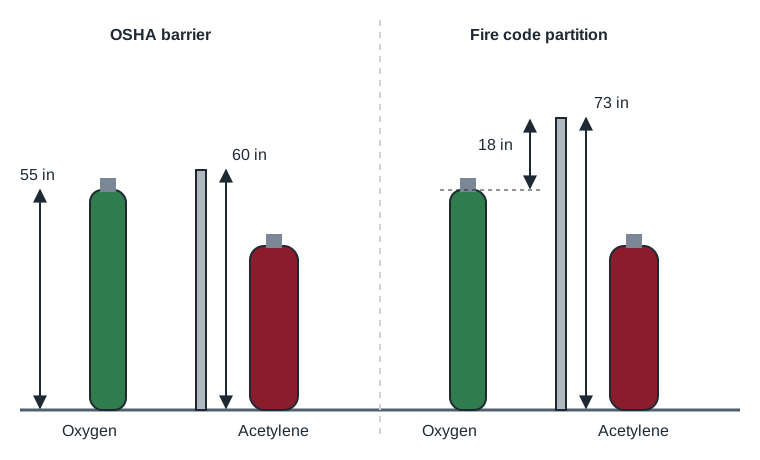
- Build to both. A barrier that is noncombustible, carries a half-hour fire-resistance rating, and stands at least 18 in above your tallest cylinder satisfies OSHA and the fire code at once. For a full-size oxygen cylinder that means roughly 6 ft or more, not 5.
- A fire rating belongs to a tested assembly. Plywood is combustible and fails the first word of the rule. A noncombustible panel also needs the half-hour rating OSHA asks for, so ask whoever builds or supplies it for the rated assembly it matches.
How much fuel gas a shop can keep inside
OSHA limits fuel gas inside a building to a total gas capacity of 2,000 cu ft (56 m3), or 300 lb (136 kg) of LP gas, not counting cylinders "in actual use or attached ready for use". The fire code's table of maximum allowable quantities is tighter: 1,000 cu ft of flammable gas per control area in storage, 1,500 cu ft of oxidizing gas, and no limit on inert gas. Each figure doubles in a sprinklered building and doubles again with approved storage cabinets, the two increases applied together.
Cylinder sizes from Matheson's dimension sheet turn those totals into counts. Where Matheson gives a range, the count uses the top of it.
| Acetylene size | Gas volume | Height | Full cylinders under the fire code's 1,000 cu ft | Under OSHA's 2,000 cu ft |
|---|---|---|---|---|
| MC | 10 cu ft | 13 in | 100 | 200 |
| B | 40 cu ft | 20 in | 25 | 50 |
| AC75 | 60-75 cu ft | 26 in | 13 | 26 |
| SM | 110-140 cu ft | 34 in | 7 | 14 |
| MED | 200-250 cu ft | 38 in | 4 | 8 |
| LG310 | 300-340 cu ft | 41 in | 2 | 5 |
| Oxygen size (nominal) | Height | Full cylinders under the fire code's 1,500 cu ft |
|---|---|---|
| 80 cu ft | 32 in | 18 |
| 125 cu ft | 43 in | 12 |
| 150 cu ft | 47 in | 10 |
| 200 cu ft | 51 in | 7 |
| 300 cu ft | 55 in | 5 |
OSHA's 2,000 cu ft is the figure welding guides repeat, but a commercial shop answers to both rulebooks, and in an unsprinklered building without gas cabinets the fire code's 1,000 binds first. Two large LG310 acetylene cylinders in storage come to 680 cu ft at the top of Matheson's range. A third takes the shop past 1,000.
Securing, caps and heat
The remaining rules deal with cylinders that fall, get hot or get hit.
| Hazard | Rule | Source |
|---|---|---|
| Falling | Secure against falling from contact, vibration or seismic activity: restrained to a fixed object, on a cart designed for cylinders, or in a rack or cabinet built for them | Fire code 5303.5.3 |
| Lying down | Secured upright at all times, except briefly while hoisted or carried | 1926.350(a)(9) |
| Acetylene orientation | Stored valve end up | 1910.253(b)(3)(ii) |
| Valve damage | Caps in place, hand tight, except in use or connected for use | 1910.253(b)(2)(iv) |
| Heat | Not exposed to more than 125 F (52 C), full or partly full | Fire code 5303.7.4 |
| Drops | Not near unprotected ledges where a fall would exceed half the cylinder's height | Fire code 5303.7.3 |
| Overhead | Not where objects can fall on them from above | Fire code 5303.7.5 |
| Empties | Valves closed | 1910.253(b)(2)(iii) |
| Oil and grease | Oxygen cylinders, valves, regulators and fittings kept free of oil and grease | Fire code 3505.3 |
Linde's acetylene safety data sheet sets its heat limit a little lower, below 50 C (122 F). A closed garage or a truck box in summer sun can pass both, and the same heat that caps tool battery storage in a vehicle applies here. This is also why acetylene does not belong in a closed tool box: the box makers' warnings covered in keeping a gas can in a truck tool box name acetylene tanks and cutting torches outright.
The falling-object rule rules out the wall under an overhead storage rack, and the space under a wall shelf loaded with heavy bins. Chain cylinders to a fixed object such as framing or a masonry wall, not to a shelf upright that can come down with them.
How long acetylene has to stand upright
Acetylene is dissolved in acetone inside a porous mass. Lay the cylinder down and the acetone no longer sits evenly in it. Linde's data sheet says the wait lets the acetone redistribute and prevents it "being carried into the flame during use causing a 'flame thrower' effect". Three suppliers give three different waits.
| Supplier document | Wait after the cylinder was horizontal |
|---|---|
| BOC Australia, acetylene cylinder safety | At least 30 minutes |
| Linde acetylene SDS HKO-001G (2022) | A minimum of 1 hour |
| BOC UK, Facts About Acetylene | 12 hours, or at least as long as the cylinder was laid flat |
The reason is the same everywhere, so the spread is margin, not a dispute about physics. The figure that binds you is your filler's. If you cannot find it, stand the cylinder up overnight, which meets every figure here for a cylinder that lay down for the drive home. Better, never lay it down: BOC Australia says acetylene cylinders "must be transported and stored vertically".
Laying out a small shop around the rule
Twenty feet is hard to find in a garage. In the 12 by 22 ft single-car layout it exists only end to end along the long walls. In a 20 by 20 ft two-car garage it exists along no wall at all, only on the diagonal through the parking bay. So a small shop uses the cart exception for the working pair and a barrier for the spares.
- One pair on a purpose-built cart. Strapped, upright, on a level floor, out of the path of the vehicle. Regulators on if you want the fire code exception as well as OSHA's.
- Spares on the wall, split by a barrier. Oxygen on one side, fuel gas on the other, each chained upright with caps hand tight, behind a noncombustible barrier with a half-hour rating, at least 18 in taller than the tallest cylinder and 18 in wider than the group on each side.
- Clear of what burns. Twenty feet from oil and other highly combustible materials for any stored cylinder, which puts the gas wall at the far end of the shop from the parts washer and the consumables shelf. At least 10 ft from combustible waste.
- Clear of what falls. Nothing overhead, no ledge, no shelf above.
- Air. Every cylinder stored indoors must be in a well-ventilated location. Acetylene is lighter than air and, BOC notes, "can rise into roof spaces", so a sealed closet or cabinet that is not vented is the wrong place.
- Count. Keep total stored acetylene under 1,000 cu ft unless the building is sprinklered or the gas is in approved cabinets. The table gives a separate 1,000 cu ft figure for gas in closed-system use, so the stored total is the spares.
Where this answer stops applying
Argon, CO2 and argon mixes are neither fuel gas nor oxidizer, so the 20 ft oxygen rule does not reach them, and the fire code sets no maximum quantity for inert gas. Securing, caps and the 125 F limit still apply to every compressed gas cylinder.
Propane has its own OSHA indoor limit, 300 lb, and its own storage code, not covered here. OSHA's standards are written for employers, and fire codes are adopted and enforced locally, so what binds a private garage is a question for the local fire marshal. The physics does not change: a private garage does not make a falling or overheated cylinder any safer, and the figures on this page are the only published ones there are.